R&D & Innovation

Lapp Innovation — Engineering the Future of Industrial Cables

14% of revenue invested in R&D. 310+ active patents. 280 engineers developing the next generation of smart, sustainable, and high-performance cable systems.

Technology Roadmap

Three pillars defining the future of industrial connectivity.

📡

Smart Cable Systems

ETHERLINE GUARD embeds fiber Bragg grating sensors into cable jackets, measuring temperature, bend stress, and tensile load in real time. Data feeds directly into SCADA and MES platforms via OPC UA.

Shipping Now

🌱

Bio-Based Materials

Our materials lab is developing castor oil-derived polyamide and lignin-based PVC alternatives that match conventional compounds in flex life, oil resistance, and fire retardancy — targeting 40% lower carbon footprint per meter.

Pilot 2027

🔌

Single Pair Ethernet

ETHERLINE T1 cables bring 10 Mbit/s connectivity over 1,000 meters on a single twisted pair — enabling sensor-to-cloud networks with 75% less cable volume and 60% lighter installed weight compared to Cat5e.

Launch Q2 2026

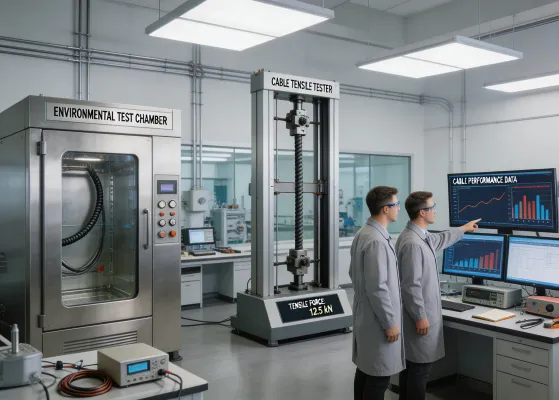
Lapp R&D testing laboratory

Stuttgart R&D Testing Center

Our Stuttgart R&D center houses 12 environmental chambers, a 10-meter EMC anechoic room, and automated flex-test rigs running 24/7. Every new cable design undergoes 2,000+ hours of accelerated aging before reaching production.

310+ Active Patents
280 R&D Engineers
14% Revenue in R&D
12 Test Chambers

Selection Considerations: Key Industry Trade-offs

Choosing the right cable infrastructure involves navigating real engineering trade-offs. Here are two decisions we help customers evaluate objectively.

Fiber Optic vs. Enhanced Copper for Last-Mile Connectivity

The case for full fiber deployment: Future-proof bandwidth capacity with lower long-term maintenance costs. Fiber delivers superior latency and reliability essential for next-generation applications like 5G backhaul and cloud-native network functions. A 2024 CRU Group study found fiber OPEX drops below copper after 7 years of operation in typical carrier deployments.

The case for enhanced copper / hybrid approaches: Technologies like G.fast vectoring and VDSL2 can deliver 1 Gbps+ over existing copper infrastructure at 30-50% lower upfront deployment cost. For brownfield installations where duct space is limited, copper upgrades enable faster rollout — months instead of years for fiber trenching. The ITU G.9701 standard continues to extend copper's usable lifespan.

Lapp's position: We manufacture both fiber and copper cable families. The right choice depends on deployment timeline, existing infrastructure, bandwidth growth projections, and total cost of ownership over a 10-15 year horizon. Our application engineers provide neutral cable selection guidance based on your specific site survey data.

Active Optical Networks (AON) vs. Passive Optical Networks (PON)

The case for AON: Dedicated bandwidth per user eliminates contention ratios. AON architectures support reaches up to 80 km without repeaters and offer simpler per-link troubleshooting. For enterprise campuses and industrial networks where deterministic latency is critical, AON provides guaranteed performance.

The case for PON: Passive splitters require no field power — reducing OPEX by 40-60% for outside plant operations (Broadband Forum TR-301, 2023). GPON and XGS-PON are the dominant architectures for high-density FTTH deployments, where shared bandwidth economics make per-subscriber costs viable at scale.

Cable infrastructure differs between AON and PON: AON typically requires point-to-point fiber runs (higher fiber count per subscriber), while PON uses splitter-based tree topologies (lower fiber count but requires splice closures). We supply both configurations and can model the fiber bill-of-materials for each architecture.

Understanding Cable Performance Boundaries

Transparent specification of operating limits ensures correct cable selection and prevents premature failures.

Temperature Range Constraints

Our standard OLFLEX cables operate reliably between -40°C and +80°C. The extended-range series reaches -60°C to +180°C, but at these extremes, maximum continuous current derating applies — typically 15-25% reduction at temperatures above +60°C per IEC 60364-5-52. Applications consistently above +105°C require silicone or ceramic fiber insulation, which we source through specialist partners.

Bend Radius Minimums

All industrial cables have minimum bend radius requirements — typically 6x to 15x the cable outer diameter for static installations, and 10x to 20x for dynamic/drag chain applications. Exceeding bend radius limits causes conductor fatigue and insulation cracking that cannot be detected visually. ETHERLINE GUARD monitoring detects bend stress but cannot prevent damage from installation errors below minimum radius.

EMC Shielding Effectiveness

Braided copper shields on our industrial Ethernet cables provide 85-95% coverage, effective for most factory environments. However, in high-EMI zones near variable frequency drives (VFDs) operating above 30 kHz, supplementary measures such as separated cable routing, ferrite cores, or double-shielded variants are required. No single cable shield eliminates all electromagnetic interference in every environment.

Interested in Co-Development?

We partner with machine builders, system integrators, and research institutions to develop application-specific cable solutions.

Explore R&D Partnerships